
What is the difference between a series LLC and a holding company?
Series LLC vs Holding Company
At first glance, it may seem as though holding companies and series LLCs are nearly the same. After all, both types of businesses have a parent company along with subsidiaries beneath them. Furthermore, both companies provide similar asset protection along with tax benefits. However, there are some important differences to note between these two types of companies, e.g., series companies tend to be comparably cost effective.
What is a Series LLC?
Series LLCs are limited liability companies in which each series serves as a distinct LLC. The series are separated as LLCs with the overarching goal of providing protection for legal liability. Therefore, if a lawsuit is filed against one series, the other series will not be held liable.
Real estate professionals sometimes use series LLCs because each separate real estate property is owned by a separate and distinct series. Series LLCs are formed similarly to regular LLCs except that the articles of formation must explicitly state there is authorization to create a series.
The original LLC is often referred to as the base, master, parent, or umbrella LLC. The series it generates can be referred to with different monikers. In the end, series LLCs boil down to important legal tools that ultimately protect assets and ameliorate the challenges of business management.
What is a Holding Company?
A holding company is a business entity, such as a corporation, LLC, or limited partnership that owns enough stock in another company to exercise control over its management and direction. A holding company doesn't actually do anything, i.e., it doesn't produce goods or services. It simply exists to hold enough shares of another company to allow it to exercise control over that company.
There are multiple reasons for creating and using holding companies. Holding companies can be used to separate the personal owners of a company and the active operating business. This allows for tax-free dividends to flow to the holding company where it will be retained until the business owner chooses to use the money for personal use.
Holding companies are commonly used simply to hold investments such as marketable securities or a portfolio of rental properties.
Series LLCs vs. Holding Companies
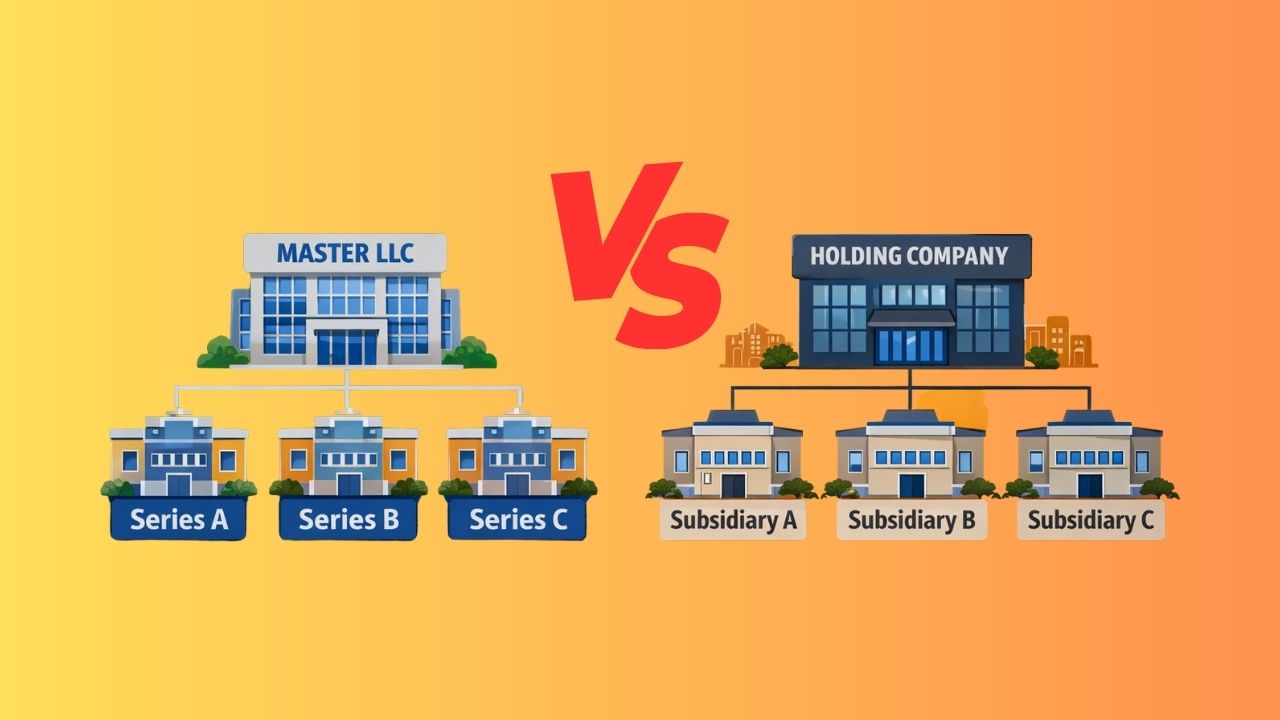
Holding companies do not actively partake in everyday business affairs. Rather, holding companies are meant to hold assets such as homes, automobiles, and property. Holding companies hold the LLC group that store assets. Each time the business owner would like to put an asset under the holding company's umbrella, a distinct LLC must be formed.
With series LLCs, however, you simply have to establish a master LLC as opposed to multiple LLCs. The master LLC is empowered to handle its own business affairs, bring in revenue, and assist in directing the growth of the series beneath its umbrella within the nuanced language of the overarching operating agreement.
Series LLCs Advantages
The primary advantage of a series LLC is the fact that it safeguards assets of every series against the liabilities of other series. Additionally, a series LLC also serves the purpose of protecting assets against liability stemming from the master LLC.
However, those who manage series LLCs are tasked with ensuring that each series is maintained separately from the other series beneath the master LLC. Though it is possible for series to share duties and costs, financial records and bank accounts cannot be shared unless the owner is willing to expose him or herself to additional liability.
Series under the master LLC can have distinct security interests, members, and reasons for existence. Series can acquire, own, or sell an array of assets ranging from intellectual property to more tangible items. Assets within a series can be held in the name of that series or in the name of the overarching master LLC.
We would be remiss not to point out the fact that those who create master LLCs have near total freedom of contract in terms of generating operating agreements. It is also worth noting series LLCs have comparably simple structures, especially when contrasted with corporations that have multiple subsidiaries. As a result, series LLCs are that much easier to operate and manage.
Series LLCs Disadvantages
In terms of drawbacks, the structure of a series LLC is somewhat shaky in the context of the law. Series LLCs are recent creations so there is limited legal precedent for conflicts concerning these entities. Series LLC liability protection has not been tested in-depth within the legal system. Furthermore, states that recognize the series LLC structure have their own distinct regulations for these nuanced instruments.
Choosing between a holding company and a Series LLC depends on your goals, risk tolerance, and the jurisdictions in which you plan to operate. A holding company offers tried‑and‑true asset protection and clarity, while a Series LLC provides innovative flexibility and potential cost savings though with some legal uncertainty.
For business owners seeking to safeguard assets, streamline management, or explore modern structures, understanding both options is essential before making a decision.
If you’re considering whether a holding company or a Series LLC is right for your business, our experienced Florida business attorneys and Rhode Island business attorneys are here to help. Call us today at 401‑272‑8300 or complete our online form to schedule a consultation and receive tailored guidance for your business needs.
Frequently Asked Questions: Series LLC vs. Holding Company
1. What is the difference between a holding company and a series LLC?
A holding company is typically a parent entity that owns separate subsidiary companies, each formed as its own LLC or corporation. A Series LLC, by contrast, creates multiple “series” under one umbrella LLC. Each series can own assets and operate independently, but without the need to form separate entities. In practice, a Series LLC can function like a holding company, but with potentially lower costs and simplified administration.
2. Is a series LLC better than an LLC?
A Series LLC may offer advantages over a traditional LLC when cost savings and administrative efficiency are priorities, since multiple series can be formed under one umbrella. However, the structure is still relatively new, not universally recognized, and has not been widely tested in court. For business owners seeking certainty, separate LLCs may remain the safer option today.
3. Can an LLC be a holding company?
Yes. A traditional LLC can serve as a holding company, owning interests in other businesses or assets without directly operating them. LLC holding companies are often favored because they are relatively easy to maintain, provide privacy, and offer liability protection for the owners.
4. What is the purpose of series LLC?
The purpose of a Series LLC is to allow multiple ventures, properties, or assets to be organized under one umbrella entity while keeping liabilities separated. Each series functions like its own LLC, but without the need to file multiple formation documents. This structure is especially popular among real estate investors and holding companies that want to segregate risk across different properties or businesses.


